The global trend of minimizing food waste has mainly focused on households, restaurants, and food stores. But to achieve real change, the food industry has an essential role to play. It’s here that we can make a substantial reduction of waste. Producing food with higher efficiency using sustainable equipment can create more yield with less energy consumption and waste. To do that, you need portioners, cookers, chillers, and freezers that are energy-, water-, and material efficient, constructed, and manufactured to obtain a minimal carbon footprint.
Setting up a sustainable production line for a plant-based product
03 Feb 2026

But setting up and maintaining a sustainable production line can be fairly complicated. To make it a bit easier, we present an interview with our expert, Christopher Fogelqvist, who will guide you along the way. Christopher is heading JBT Marel’s dedicated R&D team with 20 specialists who continuously improve our solutions to an optimal sustainable standard. Christopher is also active in The European Hygienic Engineering & Design Group (EHEDG), a global network of equipment manufacturers, food processing companies, research institutes, and public health authorities. EHEDG was founded in 1989 to promote hygiene during the production, processing, and packaging of food products, essential for a sustainable food industry. Here you can read what Cristopher thinks are the main focus areas.
How can I secure that my production line for plant-based products is sustainable?
I would say that it all starts and ends with design. When you design your processing line for sustainable plant-based protein production, there are many aspects to consider. The equipment should reduce food waste and have low energy consumption and water usage while securing high food security. The construction of the equipment is also essential; for example, the smaller it is, the less material and resources it has consumed when manufactured. At JBT Marel, we have specialists just focusing on reducing the use of materials.
What can I do to reduce food waste in the production process?
You must have total control of your production line, ensuring that the process is optimal and that everything you produce can also be used. For example, one challenge when you freeze a plant-based product is to avoid “over freezing” which causes dehydration. A high level of dehydration will affect the frozen product, making it shriveled, dry, and tough. At worst, that means the product will go to waste. But dehydration is also a form of food loss because it makes the product smaller and lighter. With dehydration of 5% and a yearly production volume of 10 000 tons, 500 tons will go to waste each year. At the same time, it’s just as important that the whole product is evenly frozen at a temperature of minus 18 °C, securing that the core has the accurate temperature.
To optimally freeze or chill any one particular food product, there are millions of potential configurations- and operating parameters that you must accurately specify. To manage this, we have developed GYRoCAP, a software that can optimize the freezing process. First, we identify and measure each critical variable that affects the product and process and upload test results to our software. Then we correlate them to all the equipment-, processing- and food product variables in our database. That way, we can help our customers to get the highest output at the lowest cost for the desired food product, reducing the risk for food waste.
Besides optimized freezing, is there more that can be done?
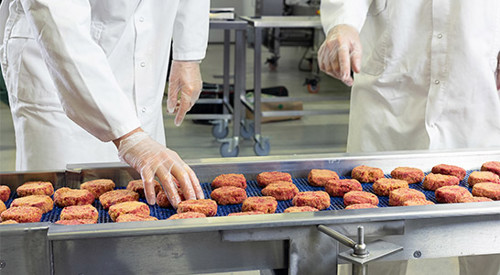
Many areas need to be addressed, but one process that can have great impact to reduced food waste and increased yield is the cutting and portioning of the product. Manual cutting is not only labour intensive but prone to inefficiency, potential contamination, and higher food waste. The introduction of our intelligent DSI waterjet cutting- and portioning system is the automated alternative which in addition to decreasing labour cost, has proven to consistently improve product yield and increase productivity. The goal is to use every part of the incoming product, so nothing goes to waste. The DSI scans every incoming product and automatically determines the optimum cutting paths to produce the desired outcome. It also evaluates how best to use any remaining product area for additional products like cubes, strips, nuggets, and more.
When optimizing energy consumption, which areas are most critical?
The freezing process is where you can easily reduce energy consumption by choosing the right type of equipment. For example, one of the challenges with a freezer is that when the warm product enters the cold atmosphere, the warm and moist air turns into frost, eventually making the freezer less efficient. To get rid of the frost, you have to defrost it, which requires stopping the production. Besides losing up-time, restarting a freezer consumes more electricity than when it is in continuous operation. At JBT Marel, we have solved this by constructing a fan-driven air balance tunnel. It minimizes the amount of moisture entering the spiral through the infeed and outfeed openings and provides an optional solution for sequential defrost. In addition, the self-stacking construction in JBT Marel spiral freezers is extremely energy efficient in itself. By offering no tension instead of low tension, it only needs a 5,5 KW motor which is half of what a traditional drum freezer requires, reducing energy consumption by almost 30%.
What more can be done to reduce energy loss when freezing?
There is a lot that can be done, of course. Still, one common challenge when optimizing energy usage is that the freezer evaporator and the compressor suction often have to be placed far apart supported by a pump system. This distance can lead to a slow reaction to changes, creating temperature fluctuations and causing uneven freezing- and energy loss. To avoid this, we have developed the Frigoscandia Low Volume System (LVS), which is up to 20% more efficient than the traditional pumped refrigerator system. It provides a dry return from the compressor eliminating the need for a refrigerant pump. The dry return also means that a Frigoscandia LVS system typically has pressure drops between 0.5 and 1°C, whereas traditional systems often have 3 – 5°C. It requires 15% less energy and 50% less refrigerant charge than conventional systems.
Why is it essential to reduce water usage in the production line?
Water is becoming a limited natural resource, and in many parts of the world, our customers now have to pay a tariff on their wastewater based on how much they produce and how clean it is. So, to be sustainable, a production line must be as efficient as possible when it comes to water usage and wastewater management. Achieving this can be a real challenge, especially for a Stein TwinDrum Spiral oven that needs continuous cleaning of the belts. That’s why we at JBT Marel have started a project that aims to add systems for water recycling to our automated clean-in-place equipment, although it already is the most water-efficient on the market.
But won’t using less water when cleaning affect food safety?
That’s a good question, and it’s important to remember that water usage is related to food safety. You want to reduce water and detergents, but you can’t compromise with hygiene requirements. One way to address this is in how you design the equipment. At JBT Marel, we work continuously with what we call Hygiene by Design. That means that we are constantly developing our equipment, like replacing bolts and washers with welded joints to eliminate potential food traps. Bacterial growth needs surfaces, so we actively design to minimize them and create coatings to prevent the occurrence of biofilm. One good example of how we work with design is our self-stacking Frigoscandia GYRoCOMPACT Spiral Freezer. It’s constructed in a way that automatically reduces the use of water and detergents. Because it has no stationary parts in the belt stack, it consumes up to 65 % less water and requires 50% less cleaning time than a traditional drum freezer.
Are there ways to optimize water usage?
Yes, fortunately, there is. Our digital solution and service offering called OmniBlu that we have developed here at JBT Marel It uses collected real-time data to provide customers a better view of their operation, improving food safety and energy savings. It can, for instance, measure and document concentrations of cleaning chemicals, as well as cleaning water volume and temperature. That way, our customers can secure that they are following cleaning procedures and prevent potential bacterial growth issues while optimizing the use of water and detergents.
Finally, what is the best about working with sustainability at JBT Marel?
It’s gratifying because sustainability has always been at the core of the company. In the ’50s, JBT Marel Frigoscandia was founded on an invention, the self-stacking freezer, that reduced energy and boosted food safety, so sustainability is in our genes. I also like how it affects every aspect of how we develop our products. For instance, by making the equipment smaller, we can save resources, reduce transportation, and minimize the equipment’s floor space. We constantly challenge ourselves, reviewing our constructions and exploring new ways to make our products more sustainable, in close cooperation with our customers and suppliers. And sustainability is also a part of our service, like our PRoCARE service contracts that offer preventive and proactive maintenance to keep energy consumption low and avoid unplanned breakdowns that would create food waste.
Get in touch
Our dedicated team is here to help and answer any questions you may have. Please complete the form, and we’ll get back to you as soon as possible. We look forward to hearing from you.